
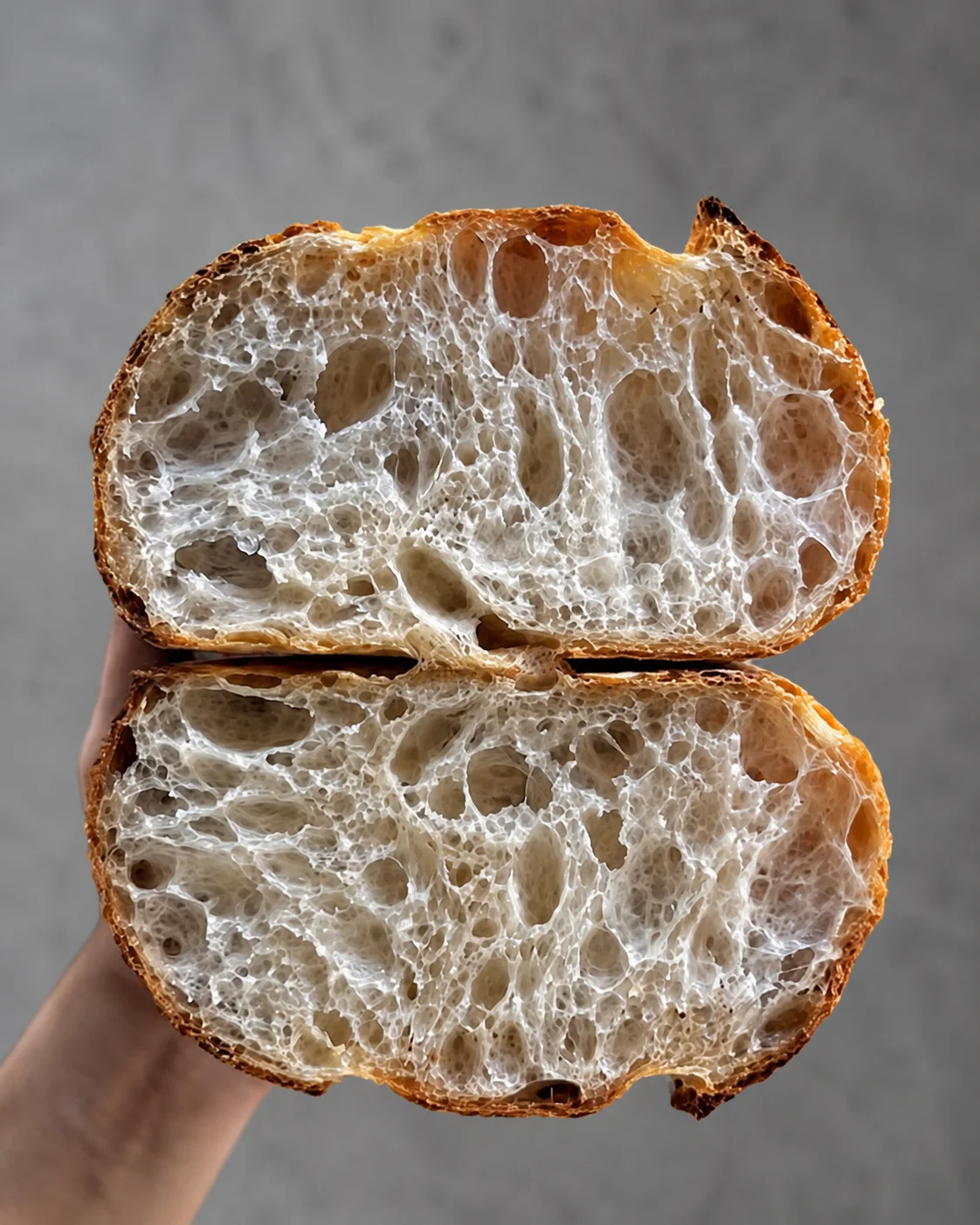
Artisan High-Hydration Sourdough Bread (80%+ Hydration Recipe)
Baking sourdough is not just a recipe—it’s a process of understanding dough, fermentation, and timing. This high-hydration artisan loaf delivers a soft, airy crumb with a beautifully crisp crust and deep flavor developed through slow fermentation.
It may not be the easiest beginner bake, but once mastered, it becomes one of the most rewarding breads you can make at home.
⚡ Batch Information
- Yield: 2 artisan loaves
- Active time: ~2 hours
- Fermentation/rest time: ~13–14 hours
- Total time: ~15–16 hours
🧠 Understanding Hydration
Hydration refers to the ratio of water to flour in your dough.
Simply put:
Hydration = Total Water ÷ Total Flour
This recipe uses high hydration (~80%+), which creates:
- Open, airy crumb
- Soft interior texture
- Light, digestible structure
- Artisan-style bread appearance
High hydration dough is wetter and more delicate, but it rewards you with superior texture.
🧾 Ingredients
This recipe is clean, simple, and focused on quality:
- 800g bread flour
- 640g water
- 240g active sourdough starter (100% hydration)
- 16g salt
🌀 Step-by-Step Method
1. Autolyse (Dough Foundation)
Mix warm water and flour until fully combined. Ensure there are no dry patches.
Let the dough rest for 45–60 minutes.
Why this matters:
- Improves gluten development
- Makes dough easier to handle
- Enhances extensibility
This step is essential for structure and elasticity.
2. Mixing the Dough
Add:
- Active sourdough starter
- Salt
Mix using your hands until fully incorporated. You should feel the dough come together smoothly.
Rest for another 45 minutes.
3. Bulk Fermentation (The Transformation Phase)
Now fermentation begins.
Let the dough rest for approximately 4 hours at a warm temperature.
Instead of relying only on time, observe the dough:
Look for:
- Noticeable rise
- Soft, airy texture
- Small bubbles forming
- Slight jiggle when moved
This is where flavor and structure develop.
4. Slap & Fold (Strength Building)
Remove dough and work it on a clean surface.
Perform:
Lift → slap → fold → repeat
Continue until:
- Dough becomes smoother
- Stickiness reduces
- Structure strengthens
Rest for 30 minutes afterward.
5. Coil Folds (Controlled Gluten Development)
Perform gentle coil folds every 30 minutes (3–5 rounds total).
Technique:
Lift dough from the center, allow it to fold under itself, rotate, and repeat.
By the end:
- Dough feels stronger
- Less sticky
- Slightly tacky but structured
💡 Windowpane Test (Pro Check)
Stretch a small piece of dough.
If it stretches thin without tearing, forming a translucent sheet:
✔ Gluten is properly developed
✔ Dough is ready for next stage
6. Check Fermentation
After bulk fermentation, the dough should be:
- Puffy and airy
- Rounded at the edges
- Full of trapped gas bubbles
If not, allow more fermentation time.
7. Preshape
Lightly flour your surface and divide dough into 2 equal pieces.
Shape gently into rounds and let rest for 30 minutes.
This helps relax gluten before final shaping.
8. Final Shaping
Shape dough into:
- Boule (round) or
- Batard (oval)
Create surface tension while preserving internal air pockets.
❄️ Cold Proof (Flavor Development)
Place shaped dough into the refrigerator overnight.
Why this matters:
- Enhances flavor depth
- Improves crust development
- Strengthens structure
Slow fermentation = better bread.
🔥 Baking Instructions
Preheat oven to 475°F (246°C).
Score dough with a sharp blade.
Bake in two stages:
- 20 minutes covered (steam phase)
- 18–20 minutes uncovered at 450°F (232°C)
⏳ Cooling (Critical Step)
Allow bread to cool for at least 2 hours before slicing.
Cutting too early can ruin:
- Crumb structure
- Moisture balance
- Overall texture
Patience improves results.
🔑 Key Success Principles
🌡️ Temperature Control
Warm dough speeds fermentation, cold slows it down. Learn to balance both.
⚡ Use an Active Starter
A strong starter = strong rise + open crumb. Weak starter = dense loaf.
🤲 Gentle Handling
High-hydration dough is delicate. Handle with care, not force.
👀 Watch the Dough, Not the Clock
Fermentation is visual, not mathematical. The dough tells you when it’s ready.
🎯 Consistency Wins
Stick to one formula until mastered. Repetition builds instinct.
💯 Final Thoughts
High-hydration sourdough is a skill-based bake. It demands patience, observation, and practice—but the result is unmatched.
Every loaf teaches you something new about dough behavior, fermentation timing, and structure building.
Even imperfect bakes are progress.